Testimony in Opposition to B20-563, RFK Stadium Study Bill

February 25, 2014

This morning, I testified on behalf of ANC 6B in opposition to B20-563, the District of Columbia Sports and Entertainment Complex Feasibility Study Act of 2013 in front of the DC Council’s Committee on Economic Development. Here is ANC 6B’s written testimony:

Good morning Madam Chair and members of the Committee on Economic Development. My name is Brian Flahaven, and I serve as chair of Advisory Neighborhood Commission 6B. My single member district, 6B09, lies in Hill East and is located immediately west of the Hill East Waterfront, also known as Reservation 13. My district also includes Barney Circle, the Historic Congressional Cemetery, and the Eastern Branch Building.

I’m here today to express ANC 6B’s strong opposition to Bill 20-563, the District of Columbia Sports and Entertainment Complex Feasibility Study Act of 2013. I’m testifying on behalf of ANC 6B, which approved my testimony 8-0 during its February 11, 2014 meeting with a quorum present.

As you know, B20-563 requires the Mayor to conduct a study to determine the “economic feasibility, economic impact and costs” of developing a new 100,000 seat superdome, indoor waterpark, soundstage, PGA-level golf course and hotel zone at the RFK Stadium, DC Armory and Langston Golf Course sites. If enacted, the bill requires the study to be completed by Feb. 15, 2015.

While we oppose this bill for a number of reasons, let me start with a point on which we and the bill’s co-sponsors do agree: there should be a comprehensive study on future uses for the RFK Stadium site, 190-acres that encompass RFK Stadium, the DC Armory, the Maloof Skate Park and surface parking lots.

However, ANC 6B believes that the best approach to determining future uses at the RFK Stadium site is a community planning process that begins with a blank slate. This is the strategy used by the city and community to develop the master plan for Reservation 13, the 67-acre parcel of land that lies immediately to the south of the RFK site.

As you may know, when Mayor Gray announced plans to move DC United to a new stadium in Southwest, he also directed Events DC, the city’s convention and stadium authority, to oversee a study on future uses of the site. While we are concerned that Events DC will only consider uses for the site that involve a new stadium, at least they are starting with a relatively blank slate and plan to engage the community.

Unfortunately, instead of starting with a blank slate, the 6 co-introducers of B20-563 have begun with the conventional wisdom that a new stadium is the best future use for the site – and then proceeded to surround the new stadium with random pet projects that will add little to no value to our neighborhood and the city as a whole.  Our commission and community were not asked by the councilmembers to weigh in on the bill, nor were we engaged by them prior to the its introduction. This is but one of ANC6B’s many objections to B20-563 – seven in total – that I am here to share with this committee.

As I’ve noted, our number one concern is the lack of community engagement in both the drafting of the bill and that envisioned during the period of the feasibility study.

Number two – the bill is duplicative. As I mentioned, Mayor Gray has already asked Events DC to conduct a study of future uses for the site. Why should DC’s hardworking taxpayers foot the bill for a second study before the first has even begun?

Number three – the proposed complex envisioned in the bill does not appear to be well-planned. Why would we build more than 1,000 new hotel rooms for a stadium that would be primarily used for 10 football games a year? If the idea is to hold more than sporting events at the complex, aren’t we competing with our own taxpayer-funded convention center which is still struggling to attract events? What happens to the DC National Guard when the Armory is turned into a soundstage? Where would the hotels, housing and retail be built since most of the RFK Stadium site sits on a floodplain and, under federal lease terms, must be used for stadium or recreational use? Why prioritize national, corporate restaurant chains and businesses over local, independent DC-owned businesses? These are just a few of a long list of questions that suggest a lack of planning in drafting the bill.

Number four – the city does not need to fund a study to determine that this plan is not feasible. The proposed complex would cost billions in taxpayer dollars with little return to the city. At most, the proposed superdome would host 10-15 events annually. You can’t host the Final Four and Superbowl every year – and a new football stadium is not going to attract the hotels and retail envisioned in the plan.

Number five – the complex lacks neighborhood-serving uses. ANC 6B believes that the RFK site should include uses that serve both visitors and residents. The sponsors in the bill seem more interested in meeting the needs of professional athletes and tourists with their proposed complex.

Number six — the Anacostia waterfront appears to be an afterthought in the plan. Any development on the site should work to connect the surrounding neighborhood to the waterfront, not act as a barrier.

And finally – we are concerned that the real purpose of the bill and study is to delay any positive development on the RFK site. For example, we are eager to see the wasteful RFK surface parking lots turned into something useful, like recreational fields. If this study moves forward, city officials working to preserve the parking lots for a future stadium will use it as an excuse to block any meaningful development in the short term.

For these reasons, we ask the committee to oppose B20-563. Let’s work together on a real, feasible study for the RFK site – one that involves the community and begins with a blank slate.

Thank you and I’d be happy to answer any questions.


*UPDATED* Weigh In Today on Absurd RFK Stadium Study Bill

February 24, 2014

On Tuesday, Feb. 25, the DC Council’s Committee on Economic Development will hold a hearing on Bill 20-563, the District of Columbia Sports and Entertainment Complex Feasibility Study Act of 2013.  If enacted, this bill would require the Mayor to conduct a study to determine the “economic feasibility, economic impact and costs” of developing a new 100,000 seat superdome, indoor waterpark, soundstage, PGA-level golf course and hotel zone at the RFK Stadium, DC Armory and Langston Golf Course sites. If enacted, the bill requires the study to be completed by Feb. 15, 2015.

As I’ve detailed in a previous post, this is a really bad bill. Instead of outlining a thoughtful, open planning process that involves the community in determining future uses for the RFK Stadium site, B20-563 begins with the conventional wisdom (a new stadium to replace the old one) and surrounds it with a random grab bag of pet projects that will do little for the neighborhood and city.

Unfortunately, six Councilmembers (Alexander, Barry, Bonds, Evans, Graham and Orange) co-introduced the bill, including three of the five members who currently sit on the Committee on Economic Development. The co-introducers need only one additional vote to get a majority on the full Council. We need to make it clear that this bill did not involve community input and lacks support in the neighborhood.

Please take a moment today to e-mail to the members of the Committee on Economic Development and urge them to oppose B20-563. Be sure to copy Robert Hawkins who staffs the committee for Chairperson Bowser. And make sure you ask that your statement be submitted for the record.

Here are the e-mails:

You can also contact Councilmember offices by phone.

Finally, you can watch the hearing (and all Council hearings) by visiting the DC Council website. The hearing will be at 10 am in Room 120. I plan to testify in opposition on behalf of ANC 6B.

Thanks for your help!

Updated 2/24/14:  If you need additional background information on the bill, I outlined my concerns about the bill in a Dec. 19, 2013 post. And here is a link to the actual bill (pdf). 


Eastern Branch Building Meeting Recap & Next Steps

February 19, 2014

We had a fantastic turnout (40+) for the Feb. 18 ANC 6B Hill East Task Force meeting on the next steps for the Eastern Branch Building. The city-owned building located at 261 17th Street SE, once a Boys and Girls Club, has been vacant since  2007. The DC Department of General Services (DGS) recently approached the ANC about plans to issue a Request for Offer (RFO) on the building. Here are the meeting highlights:

  • Michelle Chin and Stephen Campbell from the planning division within DGS opened the meeting by talking about the department’s plans to issue an RFO for the building. Coming into the meeting, their goal was to get community feedback so that the RFO could be issued as soon as possible. Chin said the department was prepared to take community comments until March 18.
  • Chin and Campbell briefly noted restrictions on uses for the building (zoned R-4 residential, lacks parking, not ADA compliant and takes up 100 percent of its lot) and clarified that the city would be looking to lease the building to an interested developer or development team. Potential city uses for the building have been ruled out at this point.
  • When the responses to the RFO are received, a technical team at DGS will score the proposals on a variety of factors, including priorities of the surrounding community. Chin said that the review process precluded a community representative from sitting on this technical review team.
  • Chuck Burger recapped the recommendations of Councilmember Wells’ Eastern Branch Task Force (Burger chaired the task force). The task force recommended uses for the building that would serve “families” and meet a number of community needs – daycare, aging and senior services, wellness and fitness and recreation to name a few. He noted that the neighborhood has changed significantly since the task force recommendations were issued in 2009 and that the community should re-evaluate the recommendations. Read the task force report and additional background on the building (pdf).
  • Almost immediately, meeting attendees raised concerns about the DGS timeline. While attendees appreciated the city’s eagerness to move on the RFO, there was a general consensus that the community needed time to consider what should be top priority uses for the building. Commissioner Francis Campbell (6B10) asked why the department was in such a rush to do something. Chin and Campbell responded that the DGS planning division is actively working to find uses for city-owned surplus properties and Eastern Branch was at or near the top of the to-do list.
  • Former Ward 6 Councilmember Sharon Ambrose voiced concern about whether the city had really taken the time to figure out what they wanted to do with the building. She questioned the expectation of DC maintaining ownership and only offering a 20-year lease in the RFO. Campbell responded that the goal was to present the development community with a “blank slate” and that DGS would be open to other lease/financing terms.
  • Various attendees voiced opinions about uses for the site. Many supported the building being used for recreational purposes while others suggested private housing and daycare. Representatives from Capitol Hill Village mentioned their interest in developing “Green Houses” on the site – small, home-like skilled nursing homes that would allow seniors to age in place.
  • There were divergent views on whether the building should be preserved or demolished. Some felt strongly that the building or at the very least its facade should be preserved , while others argued that a new building could be designed to be more accessible, usable and energy-efficient. DGS is approaching the RFO as an opportunity to develop the existing building.
  • Burger emphasized the need to make sure that any use for the building is financially viable. The economics need to work and it is likely that multiple tenants will be needed.
  • A local developer noted that developers “don’t do community centers,” and that such a public function or use should be funded by the city. Likewise, Ambrose pointed to the Hill Center at Old Naval Hospital as a model of a public-private partnership that could be replicated in this instance. When Ambrose asked if the city planned to fund Eastern Branch in the city’s FY15 capital budget, Chin and Campbell responded not at this time.
  • I asked Chin and Campbell if DGS would agree to delay the issuance of an RFO until the community and ANC 6B had a chance to weigh in with formal comments.  They agreed to delay the issuance by at least a month. When I asked if DGS would be willing to let ANC 6B review the draft RFO prior to its issuance, they responded that they could not share the draft RFO with the ANC.
  • The task force voted to recommend that ANC 6B send a letter to DGS Director Brian Hanlon thanking his team for their community outreach and reiterating the community’s understanding that DGS will not issue an RFO until they receive formal comments from the community.

As for next steps, I plan to work with my commission and task force colleagues to schedule one or two additional community meetings to develop a list of community priorities for the building. This list will be basis of ANC 6B’s formal comments to DGS on the Eastern Branch RFO. And though we had a great turnout for this meeting, I want to make sure that we spread the word far and wide about these next two meetings (if you are interested in helping flyer, let me know).

If you attended the meeting, please feel free to post your comments and reactions below. A big thanks to all who were able to attend and weigh in. And thanks to the staff at St. Coletta of Greater Washington for hosting the meeting!


Testimony on Res. 13 at Feb. 11 DMPED Oversight Hearing

February 11, 2014

This afternoon, I testified at the DC Council’s Committee on Economic Development oversight hearing for the Deputy Mayor for Planning and Economic Development . My testimony, posted below, focused mainly on the status of development plans for Reservation 13, though I also commented briefly on the Hine redevelopment. ANC 6B retroactively approved my testimony during tonight’s (Feb. 11) full commission meeting.  

Good morning Madame Chair and members of the Committee on Economic Development. My name is Brian Flahaven, and I serve as chair of Advisory Neighborhood Commission 6B. My single member district, 6B09, lies in Hill East and includes Barney Circle, the Historic Congressional Cemetery, and the Eastern Branch Building.

I’m here today to testify about the Hill East Development, also known as Reservation 13, the 67-acre former site of DC General Hospital. I’d also like to share some brief thoughts on the Hine development. I’m testifying on behalf of myself and not on behalf of ANC 6B, though the commission will consider retroactively approving my testimony at tonight’s Feb. 11 commission meeting. My testimony is consistent with ANC 6B’s support of mixed use development at Reservation 13 and the Hine PUD.

In June 2013, ANC 6B voted unanimously to support moving forward with the Donatelli/Blue Skye response to DMPED’s Request for Expressions of Interest in parcels F1 and G1 of the Hill East Development. In September 2013, DMPED announced that the city would move forward with the Donatelli/Blue Skye response. The response – which consists of two mixed-use residential/retail buildings next to the Stadium-Armory Metro– is consistent with the community-supported Reservation 13 master plan and the Hill East District zoning on the site. I believe that the Donatelli/Blue Skye plans will help catalyze development on the rest of the site, assuming Mayor Gray, DMPED and the DC Council make the investments and policy decisions necessary to make the long-stalled vision of the Hill East waterfront a reality.

Currently, DMPED and Donatelli/Blue Skye are in negotiations on a final agreement which must be approved by the DC Council. I’d like the committee to ask Deputy Mayor Hoskins and his team:

1) When do they anticipate bringing a final agreement on the first phase of the Hill East Development to the Council?
2) Since this project is finally set to begin, how much funding is the Mayor and DMPED requesting in the FY15 budget related to the Hill East Development? As I’ve mentioned in previous testimony, public funding will be needed to extend public roads/sewers, demolish buildings and to mitigate any environmental concerns on the Hill East site.

I also urge Mayor Gray and DMPED to take action immediately to prepare the remaining parcels of the Hill East site for development. Specifically, DMPED should be:

• Working with the Department of Human Services on a plan to close the temporary homeless shelter at DC General and begin transitioning homeless families and individuals into better housing options. The current policy of housing up to 300 homeless families in a dilapidated, deteriorating old hospital building completely separated from the surrounding neighborhood is an embarrassment to the city and completely counterproductive to the ultimate goal of ending homelessness. Instead, the city should be looking to other alternatives for serving the homeless population in less concentrated settings.

• Developing a plan for transitioning social services located on the site. The Reservation 13 master plan envisions, and I certainly supports, continuing to provide existing services on the site at a reasonable scale in new facilities constructed on parcel L.

To ensure that DMPED is looking beyond the first phase of the Hill East Development, I urge the committee to ask Deputy Mayor Hoskins and his team a few additional questions:

1) What is the timeline for future phases of the Hill East Development?
2) Does DMPED plan to continue developing Hill East parcel-by-parcel? Or is DMPED considering issuing one RFEI for the remainder of the site?
3) If parcel-by-parcel, what parcels are being considered for phase II?
4) Is DMPED working with the Deputy Mayor for Health and Human Services and the Department of Human Services on a plan for eventual closure of DC General?
5) Does DMPED plan to talk more about the Hill East Development in the coming year? Last year, I didn’t see the Hill East Development referenced in any of the Mayor’s presentations on economic development. I’ll be curious to see if it made DMPED’s presentation today.

After years of distractions, three RFPs and numerous delays, I’m pleased that the Hill East Development is finally moving forward. This is just the first step to bringing mixed-use development to Reservation 13. The ultimate goal remains the achievement of the Council-adopted and community supported Reservation 13 master plan which, when completed, will finally connect the eastern end of Capitol Hill to the Anacostia waterfront.

I’d also like to share a couple of additional comments on the Planned Unit Development process for the Hine School redevelopment. As you know, the Zoning Commission has approved the PUD but the project is currently stalled by pending litigation.

First, I’d like to raise the issue of transparency. I believe the record now reflects that DMPED mishandled the Freedom of Information Act request submitted by community members and needlessly delayed and limited access to information that was appropriate for the public domain. Irrespective of the content of that information and its relevance to any proceeding, the mishandling of this request undermined the spirit of the public process around these types of developments and is not consistent with the city’s commitment to an open and transparent government.

Second, I want to raise a broader point about the PUD process itself. PUDs typically happen on straight forward property purchases where the owner has full ownership and is simply seeking to obtain zoning relief through the PUD. The community and affected ANC then negotiates appropriate levels of benefits, amenities and mitigation with the owner, with the Zoning Commission eventually approving the PUD and the package of benefits. In the case of Hine, the PUD process came after and RFP process, which included a very lengthy, closed door negotiation between DMPED and the selected developer to set the terms for benefits and amenities.

I certainly understand the need for closed door negotiations after the city closes an RFP process and selects a developer. However, I also believe that the community should be involved in helping set the parameters for these negotiations, particularly when it comes to desired benefits and amenities. Our ANC approached the RFP process with a fairly well publicized and organized process, but the commission’s entire focus was on which development team to support. Presumably this was somewhat predicated on the idea that the real discussion benefits and amenities would happen in the PUD process. We now know that the major conversation on benefits and amenities happened during DMPED’s closed door negotiations with the development team. To its credit, DMPED’s aggressive negotiations produced a well-defined and directed list of benefits and amenities to be delivered by the project.
Given the experience of ANC 6B, I encourage DMPED and the Council to consider strategies or ideas on how to engage the community and ANCs in helping set the parameters for benefits and amenities in situations where a PUD follows a city-led RFP process.

Thank you for your time, and I’d be happy to answer any questions.


Updated Plans for 1500 Penn Avenue SE

February 6, 2014
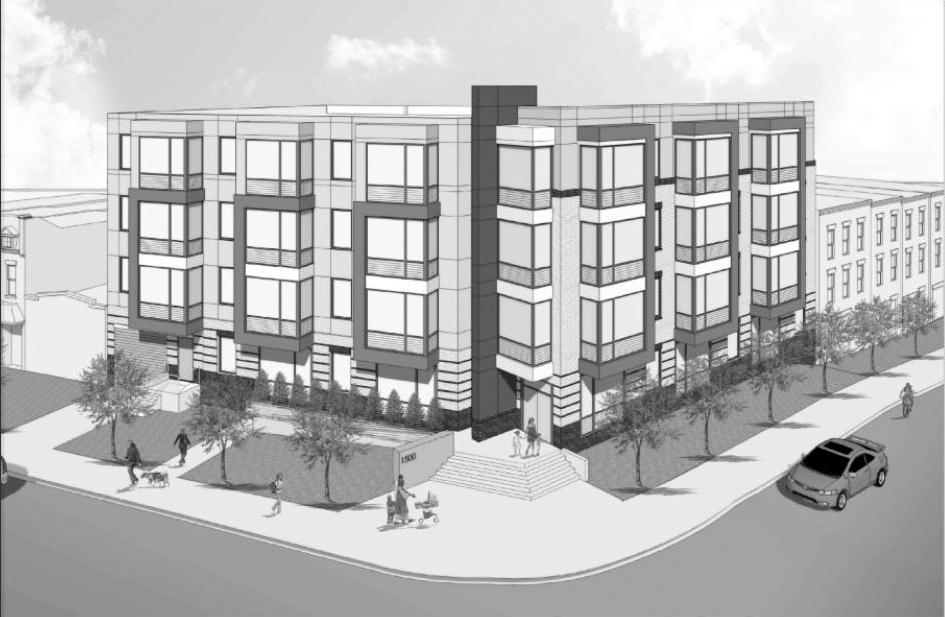
Rendering of 41-unit condo building planned for 1500 Penn Ave SE. Produced by Bonstra Haresign Architects.

Rendering of 41-unit condo building planned for 1500 Penn Ave SE. Produced by Bonstra Haresign Architects.

During the Feb. 4 ANC 6B Planning and Zoning Committee meeting, Eric May of the Goldstar Group shared updated renderings of their proposed 41-unit condo building at 1500 Pennsylvania Avenue SE. The drawings include the layout of the underground parking garage, a garage which will include 21 spaces. Goldstar is seeking a variance on parking space size requirements, seeking to count 8 compact spaces towards the 21 space minimum requirement.

May also asked the committee to weigh in on an additional variance request related to the height of the penthouse. The variance will allow the rooftop penthouse to have varying height instead of uniform height.

The committee voted unanimously to recommend that the full commission support both variance requests and the raze permit for the project. ANC 6B will vote on the committee recommendation during the commission’s Tues., Feb. 10 meeting, 7 pm at the Hill Center (921 Pennsylvania Ave SE). Meeting attendees will have an opportunity to ask questions/provide comments on the requests. If you can’t attend the meeting, please share your comments with me directly or post below.