ANC 6B December Meeting Recap

December 26, 2013

Due to the Dec. 10 weather-related closure of the DC government, ANC 6B held its rescheduled regular monthly meeting on Dec. 16. The commission had a relatively light agenda. Here are the highlights:

  • The commission voted unanimously to send a letter (pdf) to Events DC urging the agency to seek community feedback in its study of future uses for the RFK Stadium site. Events DC, which has been asked by Mayor Gray to study future uses, has posted a Request for Expressions of Interest seeking a consultant to conduct the study. Sending a letter to the agency was recommended by ANC 6B’s Hill East Task Force.
  • Responding to a request by the Office of the Deputy Mayor for Planning and Economic Development (DMPED), the commission voted 5-0 (with 3 abstentions) to support the ability of Frager’s to continue its temporary garden center on the concrete pad across from Eastern Market.
  • The commission voted unanimously to support a resolution (pdf) on the use of “Flexi-Pave” material to repair sidewalks in southeast Capitol Hill. The District Department of Transportation has started using Flexi-Pave material to repair sidewalks frequently damaged by tree roots. A section of the sidewalk on the 300 block of 7th Street SE has already been repaired using Flexi-Pave.
  • The commission voted unanimously to support the liquor license renewal for Cava Restaurant (527-529 8th Street SE) and to support striking a provision in Pennsylvania Avenue Market’s (1501 Pennsylvania Ave SE) current settlement agreement that prohibits the sale of two-packs and three-packs of beer. On Penn Ave Market, the commission voted to strike the provision because the Alcoholic Beverage Control Board has ruled a ban on two and three packs is not enforceable.
  • The commission voted 7-0 to send a letter (pdf) to DDOT urging the agency to perform a full depth reconstruction of the alley behind the west side of the 500 block of 8th Street SE (Barracks Row). The alley is in extremely poor shape and is frequently used by commercial delivery and garbage trucks.
  • Since the Zoning Commission scheduled an additional Zoning Regulations Review hearing (pdf) just for ANCs on Jan. 30, 2014, the commission voted unanimously to allow a commissioner to testify on ANC 6B’s position at the hearing.
  • The commission voted unanimously to send a letter to the DC Parks and Recreation Department reaffirming ANC 6B’s support to the Park Partnership for the Kim Brenegar Memorial Garden at 8th Street SE and North Carolina Avenue SE.
  • ANC 6B’s January meeting will be on Tues., Jan. 14, 7 pm at the Hill Center, 921 Pennsylvania Avenue SE.

Vincent Orange’s “Vision” for the RFK Stadium Site

December 19, 2013

I first learned of Councilmember (and mayoral candidate) Vincent Orange’s District of Columbia Sports and Entertainment Complex Feasibility Study Act of 2013 on November 7, the day it was introduced. The bill requires the Mayor to conduct a study to determine the “economic feasibility, economic impact and costs” of developing a new 100,000 seat superdome, indoor waterpark, soundstage, PGA-level golf course and hotel zone at the RFK Stadium, DC Armory and Langston Golf Course sites. If enacted, the bill requires the study to be completed by Feb. 15, 2015.

Based on media reports, I fully expected B20-563 to be 1-2 pages of legislative text. Instead, the bill is 15 pages long, detailing every pet project Councilmember Orange and others have dreamed up for the site. Here are some examples of what is included.

  • A proposed “hotel zone” would include a minimum of three hotels, adding a combined total of 1000 rooms to the site. The hotel zone would also include a 24/7 spa, fitness and wellness establishment that includes an Olympic size pool, leisure pool, children’s pool and sauna. And don’t forget the “health conscious café open 7 days a week featuring juice and smoothies bar, organic foods and healthy eating options.”
  • Apparently, the more than 1,000 hotel rooms in the hotel zone are not enough, because the bill also calls for another 200-300 room three star hotel to go along with the indoor waterpark resort. The waterpark also includes 15,000 sq. ft. of conference and meeting facilities. I’m not sure why you would build conference and meeting facilities in the waterpark and a pool facility in the hotel zone.
  • The detail for the hotel zone and indoor waterpark pales in comparison to the detail provided on the multimedia soundstage. The soundstage, which apparently would be in the DC Armory, includes everything from a television recording studio and production offices to green rooms and a paint shop.
  • The bill does call for retail on the site, mainly in the “Robert F. Kennedy Domed Stadium Complex” which includes the 100,000 seat stadium, two “nationally recognized” department stores, two nationally recognized family restaurant chains, one nationally recognized chain bar or nightclub, one nationally recognized high end restaurant, one nationally recognized movie theatre, one independently owned restaurant and a beer garden. The bill is silent on whether the beer garden must be nationally recognized.
  • The bill does call for some housing on the site, but it is very vague. There would apparently be affordable housing units for low-income residents and students. It is also unclear as to where the housing would be built.

This is a small sampling of the ridiculous level of detail in the bill (I didn’t even mention the required 3D model). It would be laughable, except five (!) additional councilmembers joined Councilmember Orange in co-introducing the bill – Councilmembers Alexander, Barry, Bonds, Evans and Graham. This tally is one short of a Council majority.

Apparently, almost half of the DC Council actually thinks it is worth taxpayer dollars to study Councilmember Orange’s dreamland. Why would we build more than 1,000 additional hotel rooms for a stadium that will be primarily used for 10 football games a year? If the idea is to hold more than sporting events at the complex, aren’t we competing with our own taxpayer-funded convention center which is still struggling to attract events? What happens to the DC National Guard when the Armory is turned into a soundstage? Where would the hotels, housing and retail be built since most of the RFK Stadium site sits on a floodplain and under federal lease terms must be used for stadium or recreational use? And why would we fund this study when Mayor Gray has already asked Events DC to conduct a study on future uses for the RFK Stadium site? (Events DC has already posted a Request for Expressions of Interest seeking a consultant to conduct the study)

Clearly, Councilmember Orange’s plan is not feasible and not in the best interests of the city. Instead of wasting taxpayer dollars on a poorly thought out study, the DC Council should look to fund realistic future uses for the site – uses that serve both residents and visitors. An example is the Capitol Riverside Youth Sports Park proposal, which aims to turn a portion of the stadium’s north parking lots into recreational fields. Not only is this project feasible, it also responds to a critical need for more recreational field space in the city.

What do you think about Councilmember Orange’s vision for the RFK Stadium site?


Tonight’s ANC 6B Meeting Cancelled, Rescheduled for Mon., Dec. 16

December 10, 2013

Due to the weather-related closure of the DC government, the Advisory Neighborhood Commission 6B meeting scheduled for today, Tuesday, December 10, 2013, has been cancelled and rescheduled for Monday, December 16, 2013, 7:00 PM, The Hill Center at the Old Naval Hospital, 921 Pennsylvania Avenue SE. You can view the Dec. 16 agenda on the ANC 6B website.


Southeast Blvd. Designs Look Like the Freeway It’s Replacing

November 22, 2013

Last night, the District Department of Transportation (DDOT) presented several concepts for replacing the end of the Southeast Freeway with a boulevard. While it’s supposed to reconnect Hill East to the Anacostia River, all of the designs presented prioritize through traffic instead.

The Southeast Freeway has been a barrier between the neighborhood and the river, but the new 11th Street bridges mean that the spur between 11th Street and Pennsylvania Avenue SE is no longer needed. DDOT would like to replace it with a surface street, called “Southeast Boulevard,” connecting the freeway at 11th Street to Barney Circle.

A standing-room only crowd packed the Payne Elementary School auditorium for DDOT’s public meeting on the Barney Circle-Southeast Boulevard Transportation Planning Study. At the meeting, required as part of an environmental assessment of the project under the National Environmental Protection Act, transportation planners shared design concepts for the project and gathered community feedback.
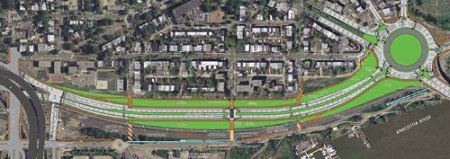
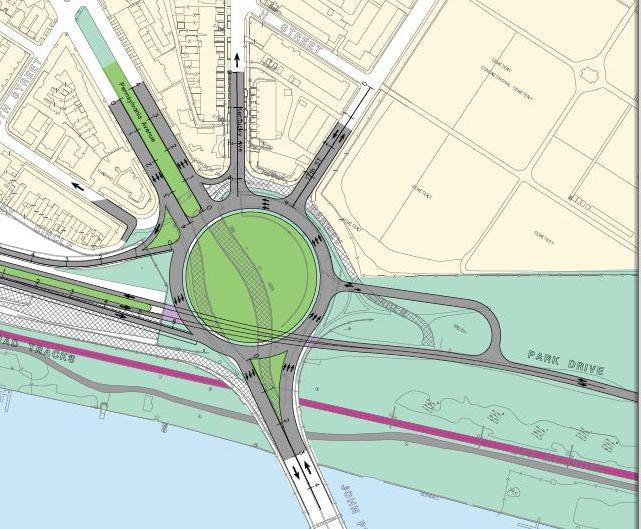
Map on Concept 2. Images from DDOT.

Map on Concept 2. Images from DDOT.

Alternatives for Southeast Boulevard and Barney Circle vary slightly

DDOT planners presented six different options they’re studying for the new street, including a “No Build” option (Concept 1) required as part of the NEPA process that would keep everything as it is today.

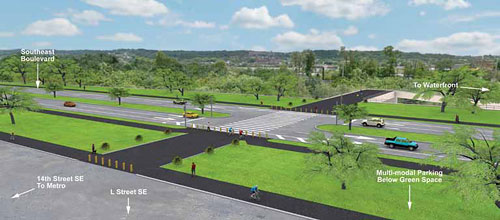
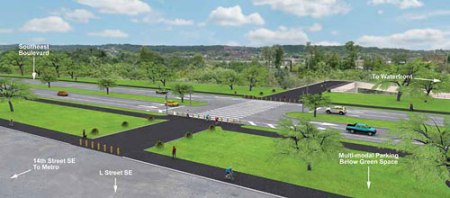
Concept 2 puts Southeast Boulevard on an elevated structure midway between L Street SE and the existing CSX railroad tracks. The boulevard would be on the same level as L Street, with green space acting as a buffer. Pedestrians and cyclists could access the waterfront by crossing the boulevard at 14th Street SE. DDOT would also build a “multi-modal” parking facility underneath the raised boulevard, with ramps off of the boulevard providing bus and car access to the parking facility.
Concept 2

Concept 2

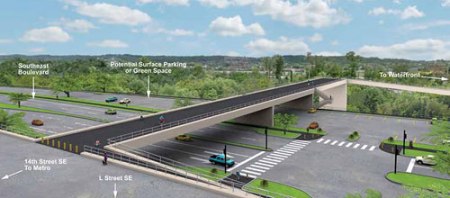
In Concept 3A, Southeast Boulevard would be at grade, below the level of L Street, with surface parking and green space next to it. There would be a foot and bike bridge over the boulevard and another surface lot to provide access to the waterfront.
Concept 3A

Concept 3A

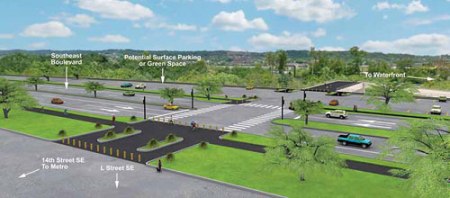
Concept 3B is similar to 3A, except the boulevard is on the same level as L Street. In this case, pedestrians and cyclists would have to cross directly over the 4-lane boulevard and surface parking lot to access the waterfront.
Concept 3B

Concept 3B

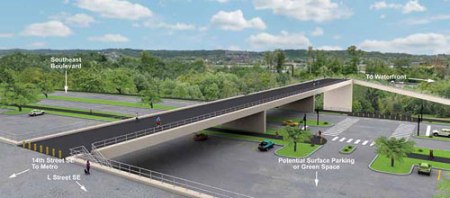
Concept 4A places the Southeast Boulevard closer to the railroad tracks and away from L Street, with a parking lot in between. The boulevard and parking would be at grade below the level of L Street. Pedestrians and cyclists would access the waterfront via a pedestrian bridge over the parking lots and boulevard.
Concept 4A

Concept 4A

Concept 4B is the same, except the boulevard is at the same level as L Street, and pedestrians and cyclists would cross the parking lots and boulevard at 14th Street.
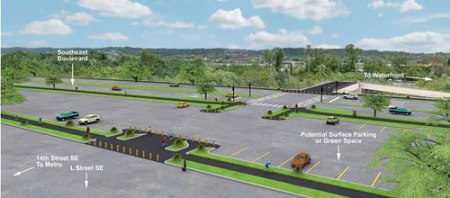
Concept 4B

Concept 4B

Planners also presented two options on the Barney Circle project, both of which would place traffic signals at the circle.

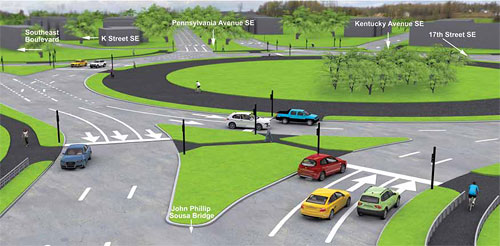
Option 1 would connect 17th Street, Kentucky Avenue, Pennsylvania Avenue and Southeast Boulevard directly to the circle. Kentucky Avenue would stay a two-way street south of Freedom Way and one-way north of it. K Street would not be connected to the circle, but you could still reach it via Pennsylvania Avenue.

In Option 2, 17th, Pennsylvania and Southeast Boulevard would connect to Barney Circle, while Kentucky Avenue would become a one-way southbound street from H Street to the circle. H Street would become a two-way street, with all-way stop signs installed at 17th & H and 16th, Kentucky and H. K Street would remain one-way, but would connect directly to the circle.
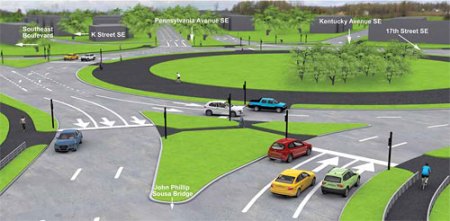
Barney Circle Option 1

Barney Circle Option 1

These options prioritize through traffic over local connections

All of DDOT’s concepts for Southeast Boulevard have three things in common: they all include a four-lane boulevard, have no connections to local streets, and include some parking element. The agency’s traffic analysis determined that the new street was necessary, connections to local strets would increase cut-through traffic and that there’s a significant need for parking.

The result is concepts that simply recreate what DDOT and the Anacostia Waterfront Initiative are trying to eliminate: a freeway that separates the neighborhood from the waterfront. The extra lanes, lack of signals and additional parking will just attract more drivers to the neighborhood during rush hour.

The designs are especially harmful to 17th Street, where Hill East residents have fought for years to reduce traffic volume and speed. DDOT proposes making 17th Street the only access point to Southeast Boulevard via Barney Circle, making it an alternative for drivers trying to avoid 295 and the 11th Street bridge.

Replace the freeway with a new street grid

If a new street is necessary, a better option is to extend the neighborhood grid by connecting the local streets, 13th, 14th, and 15th, to a two-lane boulevard with stoplights at each intersection. This would make it easier for pedestrians and cyclists to cross at multiple locations and make the boulevard a local street, rather than a freeway.

A two-lane road with multiple signals would attract less traffic, easing but not eliminating some of the pressure on 17th Street SE. Green space could provide a buffer between L Street and the two-lane boulevard. And forget the unneeded parking lots.

On Barney Circle, Option 1 appears to be preferable to Option 2, assuming that DDOT can implement traffic calming measures on Kentucky Ave SE. Option 2 exacerbates current traffic volume problems by attracting more vehicles to 16th, 17th and H streets. Without changes to the Southeast Boulevard portion of the project, both Barney Circle options make the neighborhood worse off.

If the goal of the Anacostia Waterfront Initiative is really “to reduce barriers between neighborhoods and the waterfront parks” and “provide continuous pedestrian and bicycle access along the entire waterfront,” than we need an option that replaces the Southeast Freeway with a new street grid that prioritizes local connections.

What do you think about the proposals? You can send your comments directly to DDOT at barneycircle@prrbiz.com.


Barney Circle-Southeast Boulevard Project Meeting This Thursday, Nov. 21

November 19, 2013
Rendering of the new Barney Circle from the 2005 Middle Anacostia River Crossings Study.

Rendering of the new Barney Circle from the 2005 Middle Anacostia River Crossings Study.

The District Department of Transportation is holding its second public meeting on the Barney Circle-Southeast Boulevard Project on Thursday, Nov. 21, 6:30 pm – 8:30 pm at Payne Elementary School (1445 C Street SE). The project involves the construction of a full traffic circle at Barney Circle SE and the construction of a Southeast Boulevard to connect the new circle to the SE-SW Freeway at 11th Street SE.  DDOT will be sharing potential options for the project and gathering community feedback.

This is a major project with significant implications for the neighborhood. It is particularly important for residents living along 17th Street SE and residents living near Barney Circle SE (Kentucky Ave, Freedom Way, Penn Ave, 15th St,, H Street, 16th St., G St., Potomac Ave) to attend this meeting. 

During the first public meeting on the project in February, the entire discussion was dominated by questions and concerns about the Southeast Boulevard. I’m hopeful that attendees will get a chance to discuss the Barney Circle portion of the project and its implications for bike, pedestrian and vehicle flow through the neighborhood.

My recap of the first public meeting includes more information on the project.